Your first flight is a special moment, exciting but full of questions nobody has given you a clear answer to. What do you bring? When should you arrive? What are you allowed in your luggage? What does security look like? What do you do with the car?
This guide walks through the entire process step by step, from preparing at home to the moment you sit down on the plane. It was written specifically for people flying from Sarajevo International Airport for the first time who want to know exactly what to expect.
Step 1 - Documents: What You Absolutely Need
Without a valid travel document there is no flight. That is the only completely non-negotiable part of the whole process.
Passport or ID card?
For flights within the EU and countries with which Bosnia and Herzegovina has a free movement agreement, a valid ID card is sufficient. For destinations outside the EU such as Turkey, the UAE, Saudi Arabia and the United States, a valid passport is required.
Always check the entry requirements for your specific destination on the website of the airline you are flying with. The rule of thumb: if you are not sure, bring your passport.
Document expiry
Many countries require your passport to be valid for at least three to six months beyond your date of entry. Check your passport expiry date several weeks before your flight since passport renewal can take time.
Your plane ticket
Today your ticket is most often digital, either an email confirmation on your phone or a printed copy. Both formats are accepted. We recommend having both, a printed copy and one on your phone.
Travel insurance
Not mandatory for all destinations but strongly recommended. For a Schengen visa it is required. For other destinations it is a good habit that can save you a lot of money if you get sick or have an accident abroad.
Step 2 - Luggage: What You Can and Cannot Bring
Luggage is the topic that causes the most confusion for first-time travellers, and understandably so.
Checked luggage (the suitcase you hand in at check-in)
Every airline has its own weight limit for checked luggage, most commonly 20 or 23 kg per piece, but always check with your specific airline as it varies. Excess weight is charged and can be expensive.
What is not allowed in checked luggage:
- Flammable liquids and gases such as hairspray in large quantities
- Explosive materials
- Lithium batteries with higher capacity such as laptop batteries and power banks
- Sharp objects are allowed in checked luggage but not in carry-on
What is allowed:
- Alcohol up to 70% in original packaging and within quantity limits
- Liquids without restriction, unlike carry-on luggage
- Prescription medication, though we recommend bringing the prescriptions too
Carry-on luggage (the bag you take into the cabin)
Every airline has its own limits for carry-on dimensions and weight, most commonly around 55x40x20 cm and 8 to 10 kg. Check the exact dimensions with your carrier as they differ.
The 100ml liquid rule - essential to know
All liquids in your carry-on must be in containers of no more than 100ml each, and all containers must fit into one clear plastic bag of one litre capacity. This includes perfume, creams, gels, toothpaste, shampoo and liquid or gel deodorant.
Exception: medication and baby food are allowed in larger quantities with appropriate documentation.
What is not allowed in carry-on luggage:
- Knives and sharp objects
- Scissors with a blade longer than 6 cm
- Sports equipment that could be used as a weapon
- Liquids in containers larger than 100ml
Laptops and electronics
Laptops must be removed from your bag and placed in a separate tray at the security checkpoint.
Step 3 - What to Do With the Car
This is one of the first questions first-time travellers ask, and it is worth sorting out well in advance rather than on the morning of departure.
You have three main options.
Someone drops you off and picks you up
The simplest option if you have someone available. There is a Kiss and Fly zone in front of Terminal B for brief stops. For longer waiting times when someone is picking up an arriving passenger, this zone is not practical.
Taxi
Convenient for one-way departures. For the return journey you need to book again, which can be unreliable late at night. More about taxi prices and available apps in our guide on how to get to Sarajevo Airport.
Private parking with shuttle transfer (Park and Fly)
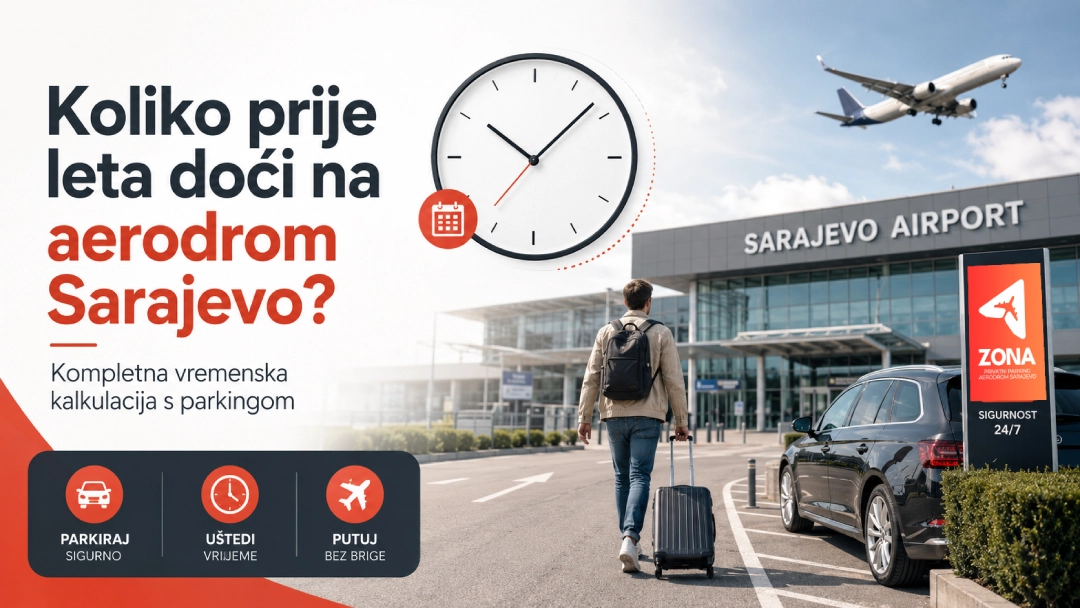
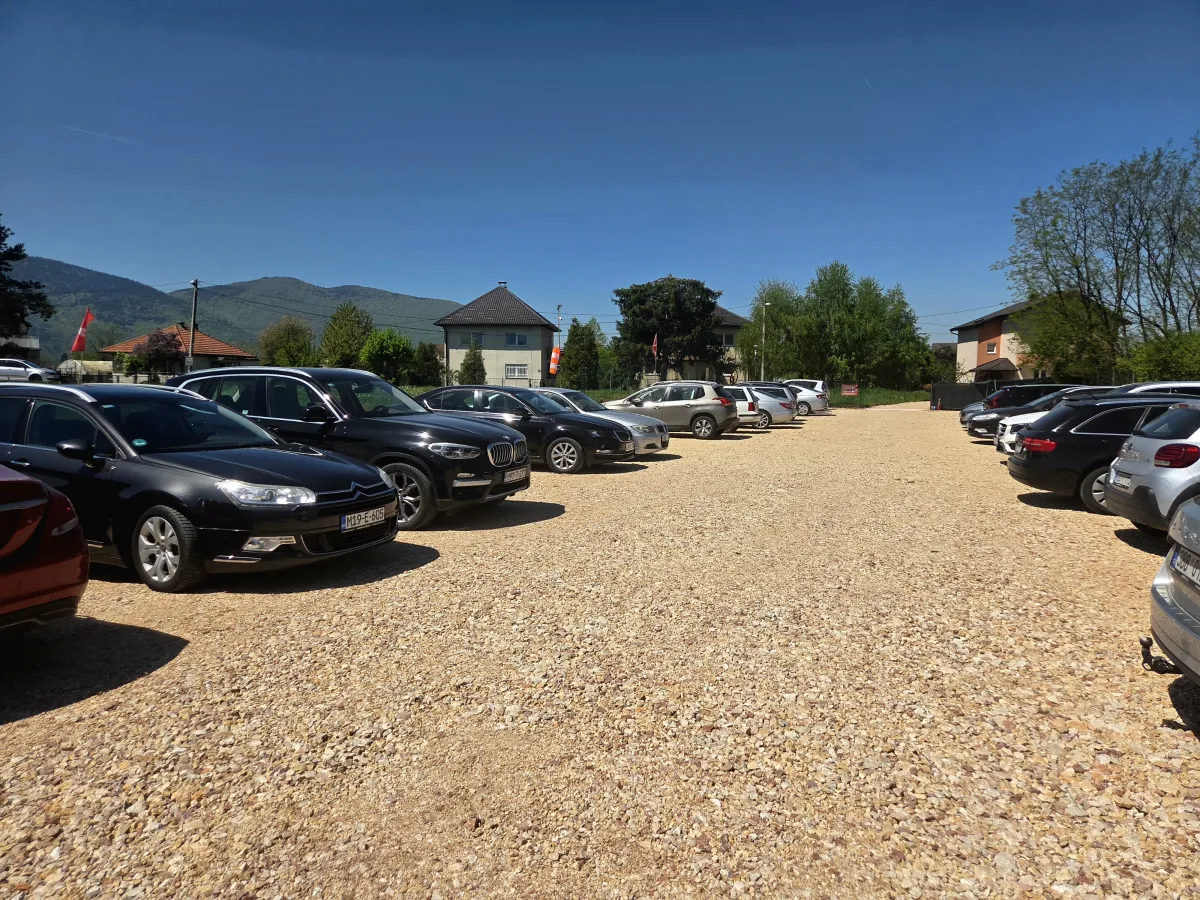
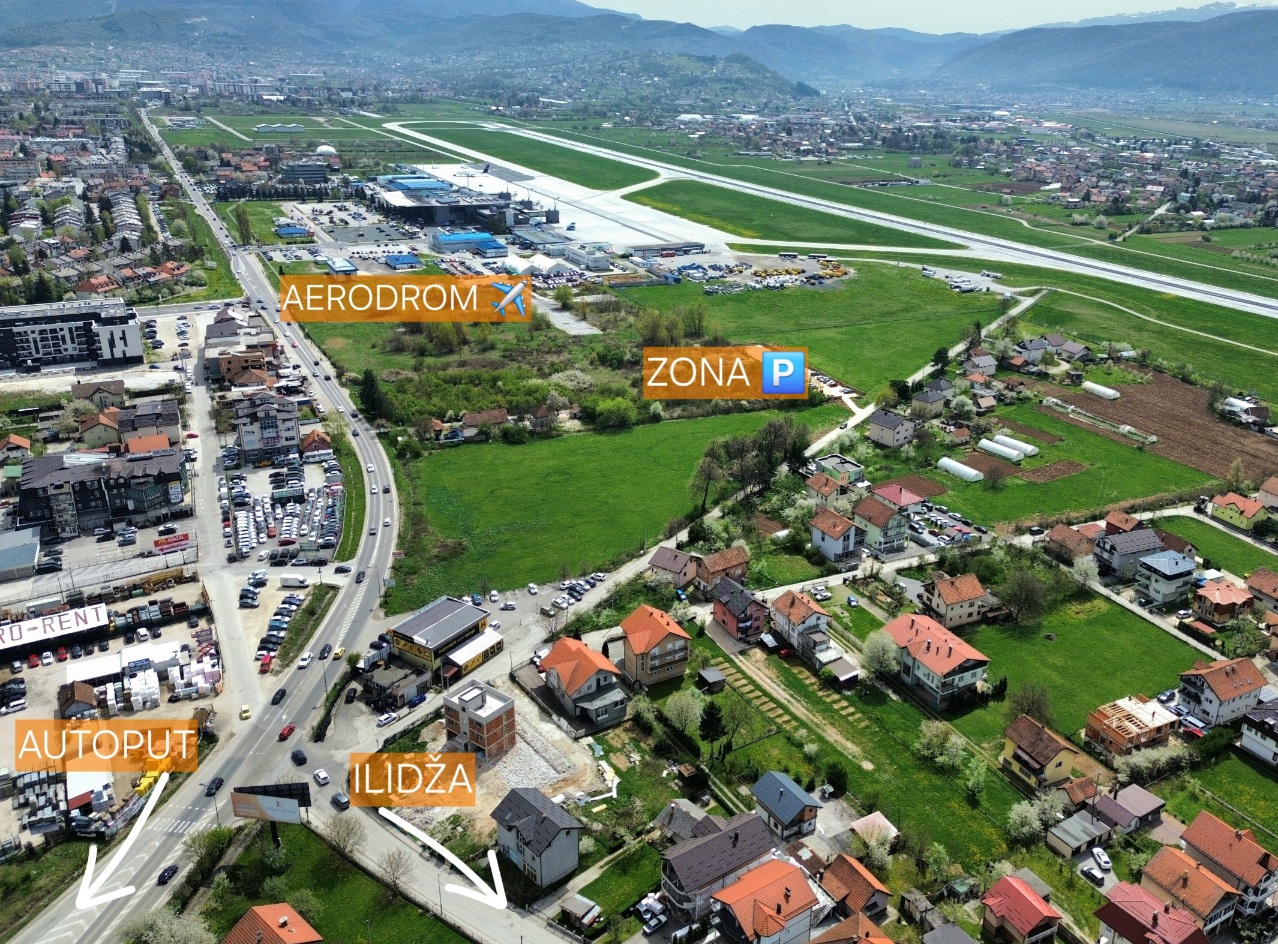
If you are driving to the airport, this is the most practical option for any trip longer than one day. You leave your car in a fenced, monitored space, a free shuttle takes you to the terminal in two minutes, and on your return the shuttle is waiting when you walk out.
ZONA Parking is two minutes from the airport, with rates of 8 to 10 KM per day depending on the length of your stay. You can read everything about how the Park and Fly model works in our Park and Fly guide, and how to make a booking in our step-by-step reservation guide.
Step 4 - When to Arrive at the Airport
This is the question that causes the most anxiety for first-time travellers, and with good reason, since missing a flight means buying a new ticket.
The general rule for Sarajevo International Airport:
- 90 minutes before departure for standard flights outside peak season with checked luggage
- 120 minutes before for flights during summer season (June to August) or destinations outside the Schengen zone
A detailed time calculation for every type of trip, including how parking affects your timing, is available in our dedicated guide on how early to arrive at Sarajevo Airport.
For first-time travellers, always choose the larger time window. It is far better to wait 30 minutes at the gate with a coffee than to run through the terminal.
Step 5 - Arriving at the Airport and Getting Your Bearings
Sarajevo International Airport is compact and easy to navigate. There are no confusing multiple terminals or long corridors to get lost in. Everything happens in one building.
When you enter the terminal you will see:
- Check-in counters on the ground floor where you hand in your suitcase and collect your boarding pass if you did not do web check-in
- An information desk for any questions
- Currency exchange offices and ATMs if you need local or foreign currency
- Duty free shops and cafes in the zone after security control
Step 6 - Check-In: Counter or Online
Web check-in (recommended)
Most airlines offer web check-in 24 to 48 hours before the flight. You check in online, choose your seat and download your boarding pass to your phone. If you have no checked luggage you can go straight to security without queuing at the counter.
Counter check-in
If you have checked luggage or did not complete web check-in, go to your airline's check-in counter. Bring your passport or ID card and your ticket. Counters close 40 to 45 minutes before departure, so do not leave it too late.
Boarding pass
Your boarding pass is your entry pass to the aircraft. It contains your name, flight number, gate, date and seat. Keep it with you since you need it at security and at boarding.
Step 7 - Security Control: How to Get Through Quickly
Security is the stage that intimidates first-time travellers the most, but it is not complicated once you know what to expect.
What to do:
First, take your laptop out of your bag and place it in a plastic tray. Then empty your pockets, keys, wallet, phone and coins all go into a tray. Remove your belt if it has a metal buckle. Place your liquids bag separately in a tray. Walk through the metal detector.
Do not carry liquids outside the clear bag, do not have prohibited items in your carry-on, and do not forget to take out your laptop. These are the three most common mistakes that slow down the whole process.
How long does it take?
Outside of peak season, 10 to 15 minutes. During summer months it can be 20 to 40 minutes. Factor this into your timing.
Step 8 - After Security: The Departure Zone
Once you have passed security you are in the departure zone, the part of the airport accessible only to passengers with a valid boarding pass.
Here you will find:
- Duty free shops for tax-free purchases including alcohol, perfume, cigarettes and chocolate
- Cafes and restaurants for food and drink while you wait
- Gates marked with numbers or letters, visible on the monitors throughout the terminal
Check the monitors for the gate number corresponding to your flight and make your way there. Boarding typically begins 30 to 40 minutes before departure.
Step 9 - Boarding
When your flight is called for boarding, either over the intercom or on the monitors, head to your gate. Bring your boarding pass and your passport or ID card.
At the entrance to the aircraft a member of the cabin crew will scan your boarding pass. Find the seat indicated on your ticket, place your carry-on bag in the overhead compartment above your seat and prepare for departure.
A note for first-time flyers
If you feel excited or slightly nervous, that is completely normal and it passes. Flying is statistically the safest form of transport. The pressure you feel in your ears during takeoff and landing is normal. Swallowing or chewing gum helps with this.
Step 10 - After Landing
When the plane lands and the captain gives permission to stand, collect your carry-on and follow the signs for:
- Passport control for flights outside the Schengen zone
- Baggage claim where you collect your checked suitcase
- Exit or Arrivals
The belt number where your bags will arrive is shown on the monitors. Wait for your bag, confirm it is yours and head out.
Frequently Asked Questions From First-Time Travellers
Can I bring food onto the plane?
Yes. You can bring food in your carry-on with the exception of liquid foods such as soups and yoghurt, which fall under the 100ml rule.
What if I accidentally pack something that is not allowed?
You will be flagged at security and asked to hand over the item or dispose of it. There is no penalty for unintentional mistakes, but the item will be confiscated.
Can I charge my phone at the airport?
Yes. Sarajevo Airport has charging points at several locations in the departure zone.
What if I forget my passport at home?
Without a valid travel document you cannot board. If you discover this at the airport, the only option is a quick return home. Always check your documents the evening before.
How many cigarettes can I bring on a flight from Sarajevo?
There are no specific aviation security restrictions on the number of cigarettes you can carry in your hand luggage. However, customs limits apply when entering your destination country. For entry into the EU, you are allowed to bring 200 cigarettes (one carton) duty-free. For Turkey the limit is 200 cigarettes, and for the UAE it is 400 cigarettes. A lighter may be carried in hand luggage (one per person) but never in checked luggage. Matches are permitted in hand luggage. E-cigarettes and their chargers must always be carried in hand luggage and never in checked baggage.
Can I bring a bottle of water onto the plane?
Bottles of liquid purchased in the duty free zone or at cafes inside the airport after security can be taken on board freely. Bottles from outside the airport cannot, unless they are under 100ml.
Can children travel alone?
Unaccompanied minors will be accepted on a flight provided they have a valid travel document and a notarised parental consent form. Rules are set by the individual airline, so contact your carrier directly for details.
What to Pack for a Comfortable Flight
- Earphones or noise-cancelling headphones for the sound of the engines
- A neck pillow for longer flights
- A phone charger for the airport and on board since some seats have USB ports
- A small amount of cash in the currency of your destination for immediate needs on arrival
- Any medication you need always in your carry-on, never only in checked luggage
Flying becomes routine after your first or second trip. This guide has covered everything you need to know for that first journey. If you have any questions about parking and getting to the airport, book your ZONA Parking spot in advance and head off without worrying about your car.
For more tips on preparing for your departure from Sarajevo Airport, take a look at our traveller's guide on what to prepare before your flight.