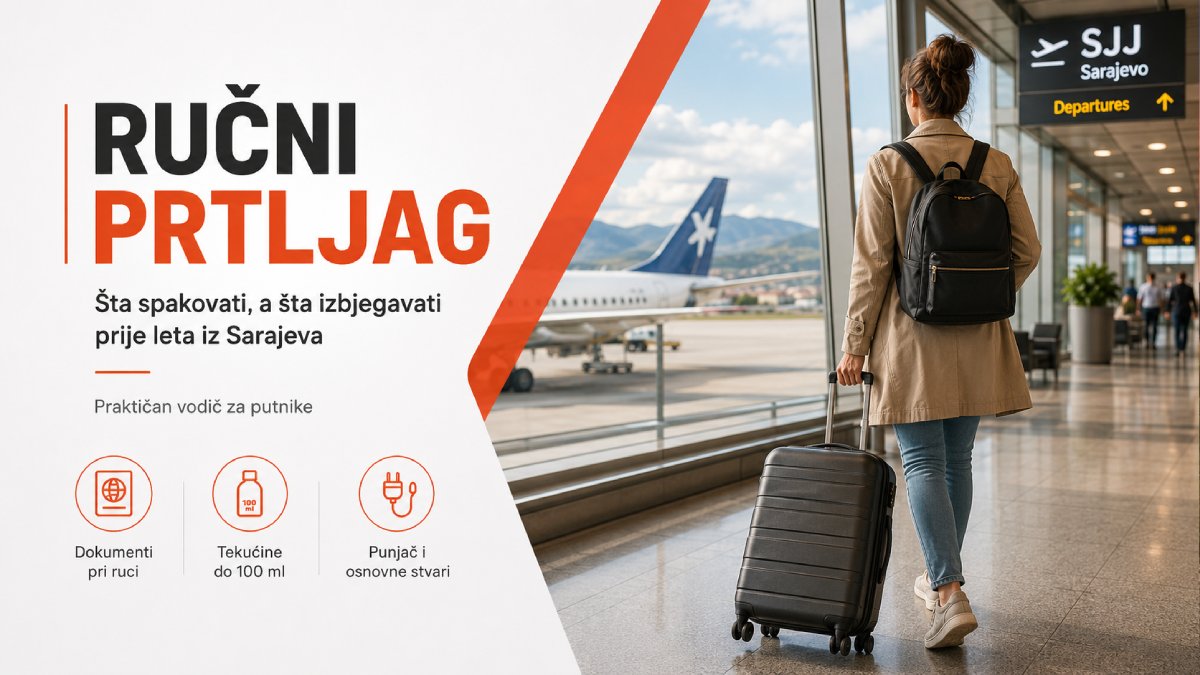
Hand luggage is the bag we often underestimate while packing, but it becomes one of the most important things once we arrive at the airport. It contains documents, phone, charger, medication, children’s items, snacks, headphones and everything else that may be needed before boarding the plane.
If you are flying from Sarajevo International Airport, preparing your hand luggage well can save time, reduce stress at security control and help you avoid searching for important items at the last moment.
This guide is for travelers who want to pack their hand luggage practically and calmly: what to bring, what to avoid, how to pack liquids, where to keep documents and how to prepare faster for the flight.
Why is hand luggage more important than you think?
Hand luggage is not just a small bag you carry onto the plane. It is your “control bag” from the moment you leave home until the moment you sit down in the aircraft.
Your checked suitcase can contain clothes, shoes and things you will not need immediately. But everything you may need at the airport, while waiting or during the flight should be in your hand luggage.
Well-packed hand luggage helps you:
- find documents faster,
- pass security control more easily,
- avoid opening your large suitcase unnecessarily,
- have basic items with you if the flight is delayed,
- travel more calmly with children,
- avoid unnecessary repacking at the airport.
The best rule is simple: everything you may need before, during or immediately after the flight should be within reach.
What should you always put in hand luggage?
Before thinking about clothes, cosmetics and small extras, first pack the essential items you cannot travel without.
Always keep these items in your hand luggage:
- passport or another valid travel document,
- boarding pass or booking confirmation,
- phone,
- charger or power bank,
- wallet and cards,
- basic medication you use,
- car or house keys,
- headphones,
- tissues,
- a light snack if needed.
Never put your documents in the suitcase you check in. If the suitcase goes into the aircraft hold, your documents must stay with you.
If you are flying for the first time and are not sure how the whole process works, read our guide first time flying from Sarajevo Airport.
Documents, phone and chargers: items that must be easy to reach
At the airport, you will use your documents several times: at check-in, baggage drop-off, security control, passport control if applicable and boarding. That is why you should not keep them in a bag you need to constantly open and search through.
The most practical solution is to have a small compartment or separate pouch for:
- passport or ID card,
- boarding pass,
- parking or accommodation confirmation,
- travel insurance,
- any consent documents for children traveling abroad.
Charge your phone before leaving home and keep the charger in your hand luggage. If your boarding pass is only on your phone, battery life becomes more important than it may seem.
If you use a power bank, keep it in your hand luggage, not in checked baggage. Battery rules may depend on the airline, so it is useful to check restrictions before traveling.
Liquids in hand luggage: the 100 ml rule
One of the most common mistakes when packing hand luggage is liquids. Travelers often bring perfume, shampoo, gel, cream or toothpaste in larger packaging and only realize at security control that this may be a problem.
In hand luggage, liquids, gels and aerosols should usually be in individual containers of up to 100 ml. These containers are normally placed in a transparent plastic bag with a total capacity of up to 1 liter.
Liquids usually include:
- water and drinks,
- perfumes,
- creams,
- gels,
- shampoos,
- toothpaste,
- spray or gel deodorants,
- liquid makeup,
- syrups and similar products.
If you are not sure whether something counts as a liquid, treat it as a liquid and pack it in a small container. Larger containers should go into checked luggage.
What should you not carry in hand luggage?
Some items are not allowed in cabin luggage because they may represent a security risk. Travelers most often make mistakes with items that seem harmless at home but can be a problem at the airport.
You should not put these items in hand luggage:
- knives, blades and similar sharp objects,
- scissors that do not meet security rules,
- tools,
- large bottles of liquid,
- flammable materials,
- sprays that are not allowed,
- objects that may look like weapons,
- souvenirs containing sharp or metal parts.
If you are unsure, it is better to place the item in checked luggage or check the rules before departure. Be especially careful with souvenirs, pocket knives, metal objects and tools.
It is important to separate two things: security rules and airline rules. Security control determines what can pass into the cabin, while the airline determines the dimensions and weight of hand luggage.
Hand luggage size and weight depend on the airline
There is no single universal rule for hand luggage size that applies to all airlines. Some tickets include only a smaller backpack, some allow a cabin suitcase, and with some airlines a larger cabin bag costs extra.
Before departure, check:
- whether your ticket includes hand luggage,
- allowed dimensions of the bag or suitcase,
- allowed weight,
- whether you may carry an additional small bag,
- what is charged extra.
This is especially important if you are flying with a low-cost airline. A small difference in dimensions can mean an additional fee at the airport.
Medication, children’s food and special needs
Medication you use regularly should always stay in your hand luggage. Do not rely on your checked suitcase always being immediately available, especially if you have a connection or a longer trip.
It is practical to keep medication in its original packaging, especially when traveling abroad. If you use specific therapy, bring a medical report or doctor’s note if you think it may be needed.
When traveling with children, hand luggage should be adapted to their needs. This may include:
- children’s food,
- a bottle,
- wet wipes,
- spare clothes,
- diapers,
- a favorite toy,
- something to calm the child while waiting.
If you are traveling as a family, you can find more practical tips in our guide traveling with children from Sarajevo Airport.
Electronics and batteries: what should stay in the cabin bag?
Phone, laptop, tablet, camera, headphones and chargers usually go in hand luggage. Besides being useful during the trip, valuable electronics are safer with you than in checked luggage.
Keep these items in your hand luggage:
- phone,
- laptop or tablet,
- chargers,
- power bank,
- headphones,
- camera,
- travel adapter if needed at your destination.
Before security control, prepare electronics so you can easily take them out if staff ask you to. This saves time for you and the passengers behind you.
Hand luggage when traveling early in the morning
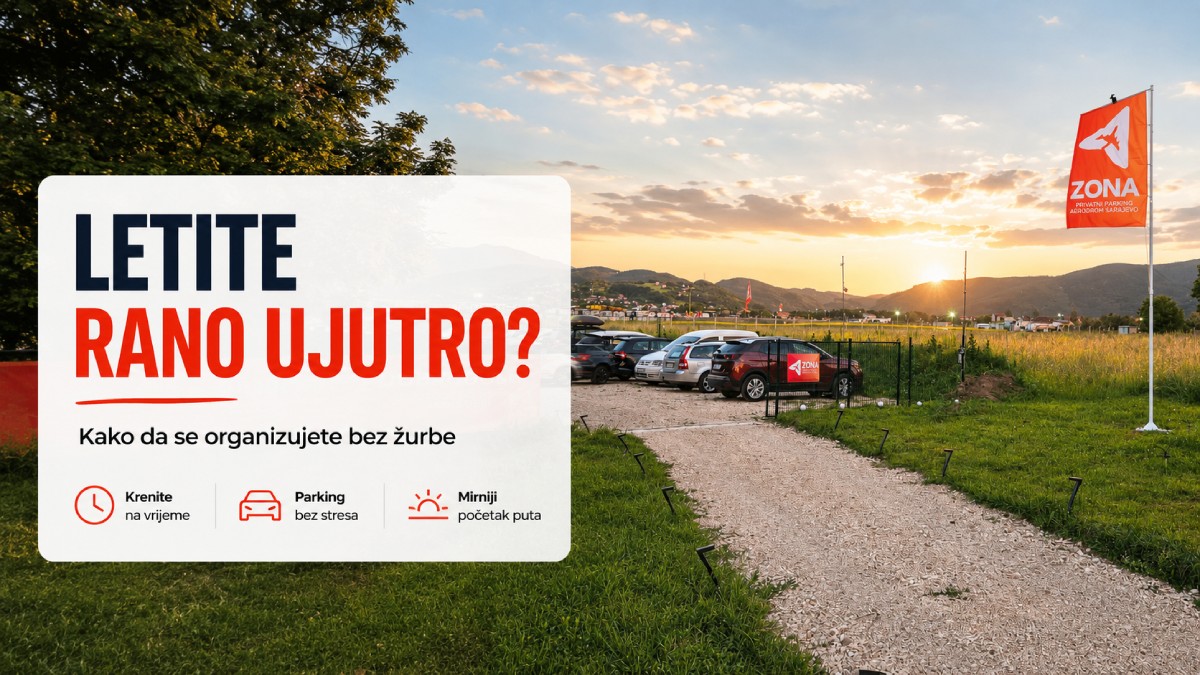
For an early morning flight, hand luggage should be even simpler. At 4 or 5 in the morning, you do not want to search through several bags for documents, headphones or a charger.
The night before your flight, prepare one smaller bag with:
- documents,
- phone,
- charger,
- wallet,
- keys,
- boarding pass,
- basic items for waiting.
If you are flying early in the morning, our article flying early from Sarajevo may also help you organize your trip without rushing.
How to pack so you pass security control faster?
Security control is faster when things are organized. Problems start when a traveler begins searching for a laptop, liquids, documents or metal items only at the control point.
To prepare faster:
- put liquids in a separate transparent bag,
- keep electronics easy to reach,
- do not place metal objects deep inside the bag,
- keep documents in a separate compartment,
- do not carry unnecessary items,
- check your pockets before security control.
Good hand luggage is not the one that is full, but the one where you can quickly find what you need.
What to put in hand luggage if you arrive by car?
If you come to the airport in your own car, your hand luggage should be organized so that important items do not stay in the trunk, on the back seat or in a bag you accidentally leave in the vehicle.
Before leaving the car, check:
- documents are with you,
- phone is with you,
- wallet is with you,
- keys are with you,
- boarding pass is available,
- the bag with liquids and electronics is within reach.
If you leave your car at a parking lot, it is useful to know in advance where you are going and how you will get to the terminal. For travelers who want simpler organization, ZONA Parking offers private parking near the airport and shuttle transfer to the terminal.
You can reserve parking in advance on the Sarajevo Airport parking reservation page.
Park and Fly and hand luggage: why is it easier when you have a plan?
With Park and Fly travel, you arrive by car near the airport, leave your vehicle at a parking lot and continue to the terminal by organized transfer. This can be practical because you do not have to think about where to leave your car or how far you will walk with luggage.
When your hand luggage is well organized, the whole process is easier: leaving the car, transfer to the terminal, check-in and security control.
You can read more about this way of traveling in our article Park and Fly Sarajevo: what it is and how it works.
Most common hand luggage mistakes
Most hand luggage problems happen because travelers are not sure what they need, what they are allowed to bring and where they packed each item.
The most common mistakes are:
- putting documents in checked luggage,
- bringing liquids in large containers,
- not checking hand luggage dimensions with the airline,
- packing scissors, a pocket knife or tools in the cabin bag,
- keeping the charger at the bottom of the suitcase,
- forgetting medication,
- carrying too many things “just in case”,
- not preparing anything for a child during waiting time.
Good hand luggage does not mean carrying everything. It means carrying what you actually need.
Short checklist before departure
Before you leave for the airport, check whether your hand luggage contains:
- passport or ID card,
- boarding pass,
- phone,
- charger,
- wallet,
- keys,
- basic medication,
- liquids in allowed packaging,
- headphones,
- tissues,
- a snack if needed.
Before security control, check:
- liquids are easy to reach,
- electronics are easy to reach,
- there are no metal objects in your pockets,
- you are not looking for documents at the last moment.
Conclusion
Hand luggage can make your trip much easier if you pack it wisely. Keep the most important things within reach, pack liquids according to the rules, separate documents in a dedicated compartment and avoid carrying items that may cause problems at security control.
Always check size and weight rules with your airline because they differ depending on the ticket. Security rules for liquids and prohibited items should also be checked before departure, especially if you are unsure about a specific item.
If you also want to organize your arrival at the airport without rushing, plan parking, departure time and transfer to the terminal in advance. When your bag, documents and parking are ready, the trip starts much more calmly.